Beyond the Mind's Edge (BMe) Model
Understanding why we think, react, and move through life the way we do.
The BMe Model builds upon attachment, neurodevelopment, and nervous system research to explore a simple but powerful idea: our ability to handle life develops over time.
From the earliest years, experiences help shape how we learn to feel safe, regulate emotions, build skills, relate to others, and respond to everyday challenges.
At the center of the BMe Model is this progression:
Safety supports regulation.
Regulation supports skill development.
Skills strengthen resilience.
Resilience expands our ability to handle life.
This developmental process influences how we navigate relationships, parenting, emotions, health, stress, and the demands of everyday life.
The BMe Model explores how early experiences—especially during childhood—can shape the patterns people continue using into adulthood.
Developmental neuroscience suggests that early experiences help organize how the brain and body learn to respond to challenge, connection, and change over time. During childhood, people are not simply learning information—they are learning patterns for responding to life. These patterns can influence emotional regulation, coping, relationships, and how much effort daily life requires.
Understanding these patterns is not about blame or reliving the past. It is about making sense of the present and strengthening the conditions that support greater flexibility, stronger relationships, and resilience moving forward.
Why Understanding Early Life Matters
Many of the patterns people experience later in life—feeling overwhelmed, pushing through exhaustion, reacting strongly under pressure, struggling to slow down, or feeling like life takes more effort than it should—are often connected to how the brain and body learned to respond during early development.
These patterns are rarely random.
From the earliest years, the developing brain is learning through repeated experiences:
Is the world safe?
What happens when I have needs?
How do I handle stress, emotions, and relationships?
Over time, those experiences can shape automatic ways of responding that continue into adulthood. The BMe Model helps explain how these patterns develop and offers a different lens—moving the conversation away from blame and toward understanding. Because when we understand where patterns came from, we create more opportunity to build new ones.
Relationship + Biology
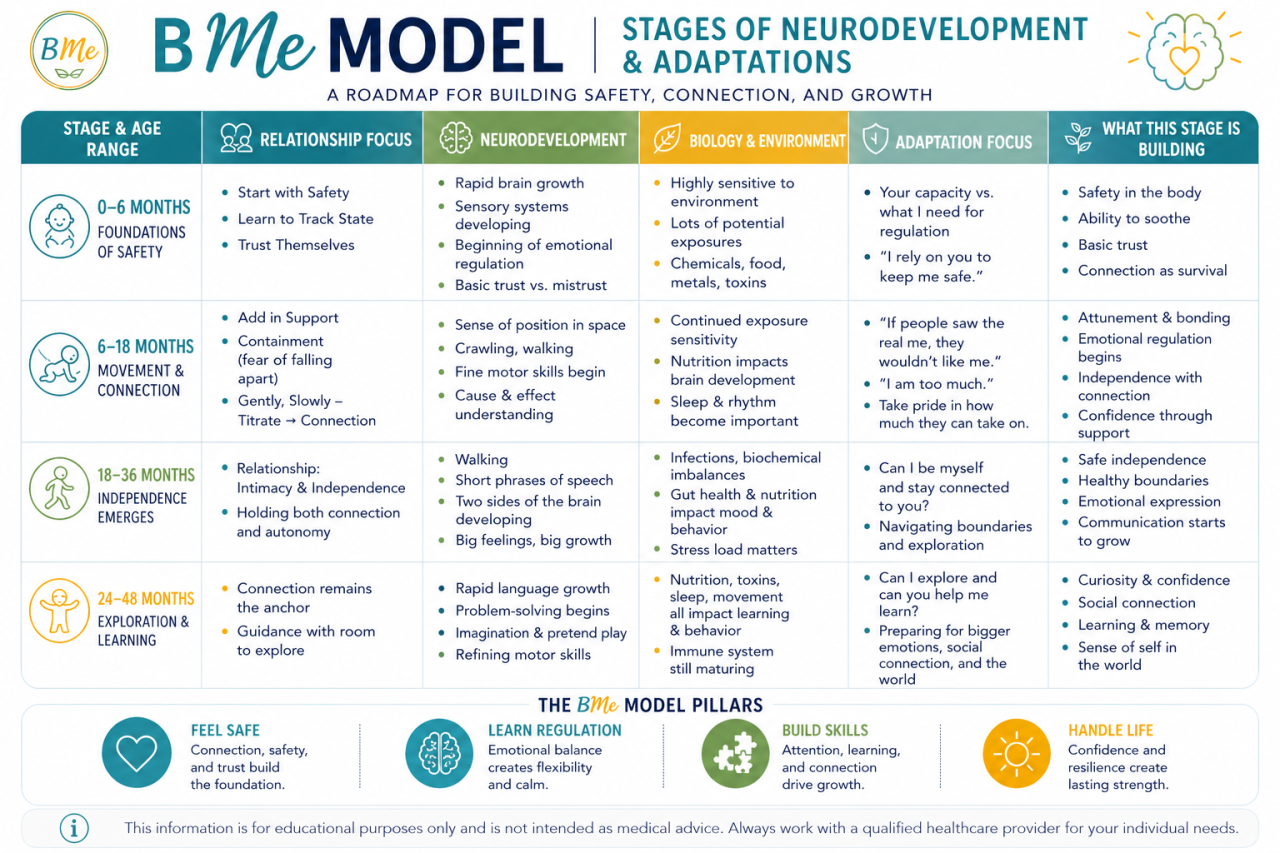
Why The First Seven Years Matter
The first seven years represent a period of rapid growth and learning—not just academically, but emotionally, socially, and biologically.
During these early years, children are developing foundations that influence how they experience and respond to life. They are learning:
• how safe the world feels
• how emotions are experienced and expressed
• how relationships work
• how to view themselves and others
• how to respond during challenge, uncertainty, and change
Development is shaped through the interaction of relationships and biology.
Relationships help children learn connection, trust, and emotional balance. Biology influences how children process experiences through factors such as sleep, nutrition, movement, health, sensory experiences, and individual differences.
When experiences feel overwhelming—or support is inconsistent—the developing stress response system may become more protective over time. Supportive relationships help buffer adversity and strengthen the skills that support healthy development.
These early patterns can continue quietly into later life—not as permanent outcomes, but as learned ways of navigating the world.
The BMe Model draws from developmental neuroscience, attachment science, stress physiology, and relational development to help explain how early experiences shape patterns—and how awareness creates opportunities for growth, flexibility, and resilience over time.
The BMe Model Explained
The BMe Model describes how early experiences help shape the nervous system stress response, influencing how people react to pressure, conflict, and emotional challenges later in life. It highlights three key ideas:
Early Experiences
The BMe Model describes how early experiences can influence the patterns people use to move through life.
From the beginning, children are learning from repeated experiences—not just what to think, but how to respond to challenge, connection, emotions, and everyday life.
The model is built around three ideas:
1. Early Experiences
Children develop through ongoing interactions with relationships, environment, and biology. Experiences of connection, safety, stress, predictability, and support all contribute to how development unfolds.
2. Learned Patterns
Over time, repeated experiences become familiar ways of responding to life. Patterns may show up through:
- responses to challenge and pressure
- emotional reactions
- relationship expectations
- coping strategies
- beliefs about self and others
3. Awareness and Growth
Understanding where patterns come from creates space for greater awareness and less self-blame.
The goal is not to relive the past or assign fault—it is to recognize what was learned and strengthen the conditions that support growth moving forward.
The BMe Model helps families move from asking: “What’s wrong with me?” to “What may have shaped this—and what can I build from here?”
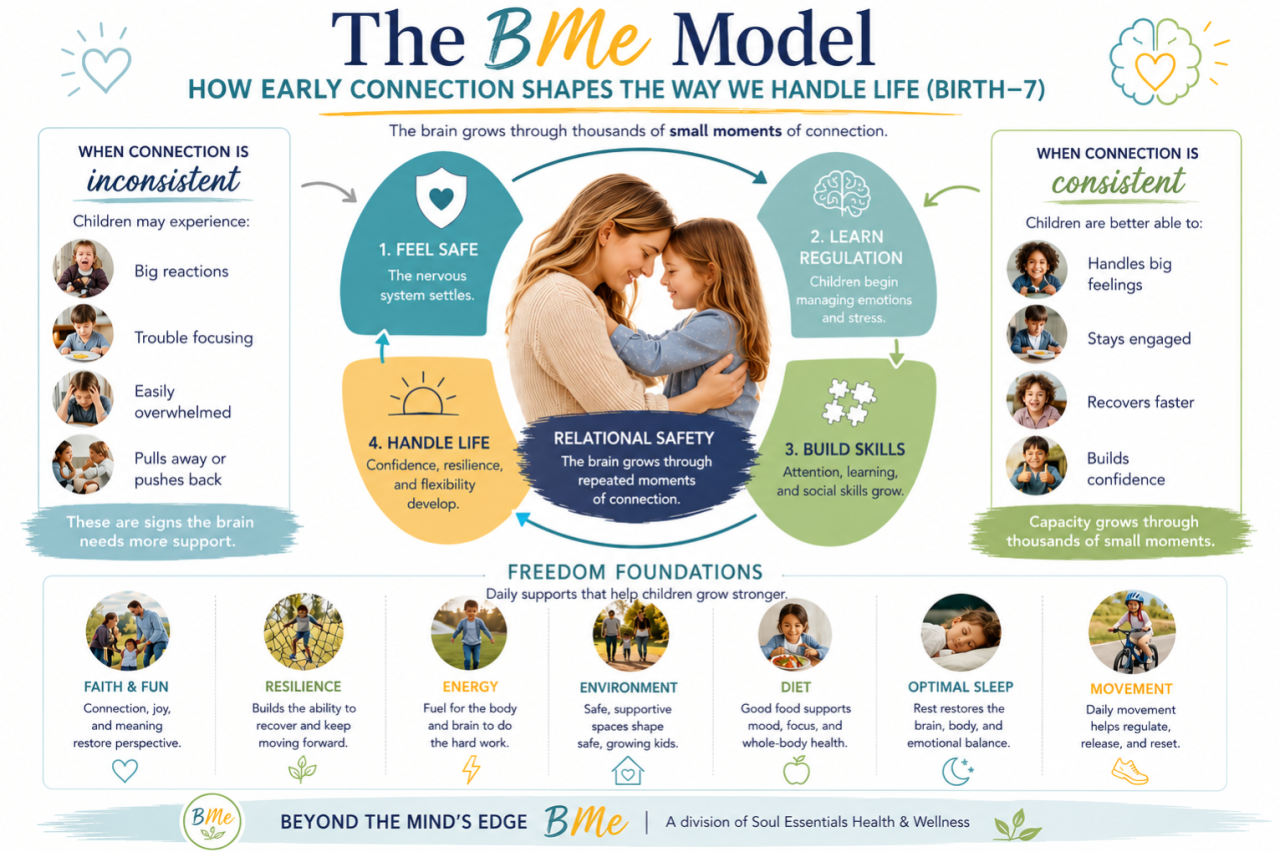
Why These Patterns Show Up in Adulthood
Many capable adults spend years doing what they have always done—showing up, pushing through, caring for others, achieving, adapting, and carrying responsibility.
Until one day life starts feeling harder than it seems like it should.
For some, this looks like chronic stress, overwhelm, emotional exhaustion, difficulty slowing down, feeling reactive, or feeling disconnected from themselves and the people they care about.
These experiences are often described as burnout. But when viewed through the lens of development, they can begin to make more sense.
The BMe Model suggests that many of the ways people respond to challenge are not random—they are often learned patterns shaped over time through repeated experiences, relationships, environments, and adaptation.
These patterns may once have been useful.
But what helped someone function in one season of life may begin requiring more effort than it gives back in another.
This is where the Burnt, Not Broken perspective becomes important.
People are not broken.
Many adults are carrying systems that learned to work hard, stay alert, stay independent, stay responsible, or keep going—even when support was limited.
The goal is not to label people or assign blame.
The goal is to strengthen the conditions that help people respond differently moving forward.
These conditions include:
- supportive relationships
- safe and stable environments
- emotional awareness
- everyday habits that support regulation and resilience
Understanding the pattern is not the finish line. It becomes the starting point for building a different way forward.
How the BMe Model Connects to the Burnt Not Broken Method
The BMe Model helps explain where patterns may begin.
The Burnt, Not Broken Method (BNB) focuses on what people can do moving forward.
Understanding early experiences can create awareness—but awareness alone does not create change. Many people already understand their story. What they often need is a practical way to build more support, strengthen everyday rhythms, and respond to life differently.
That is where the Burnt, Not Broken Method begins.
Rather than asking people to push harder or become someone new, BNB focuses on creating the conditions that help people function with greater flexibility, resilience, and confidence over time.
The Burnt, Not Broken Method
Restore Capacity
Reduce overload and strengthen the foundations that help people feel more supported and steady. ↓ Stabilize Family Rhythm Build sustainable routines, relationships, and environments that support everyday life.
↓
Build Resilience
Develop the skills, awareness, and supports that help people respond to challenges with greater flexibility over time.
The BMe Model explains why patterns exist.
The Burnt, Not Broken Method focuses on how people move forward.
Together, they create a relationship-centered approach that moves from understanding → support → growth.
The FREEDOM Foundations provide the everyday supports that help make that growth sustainable.
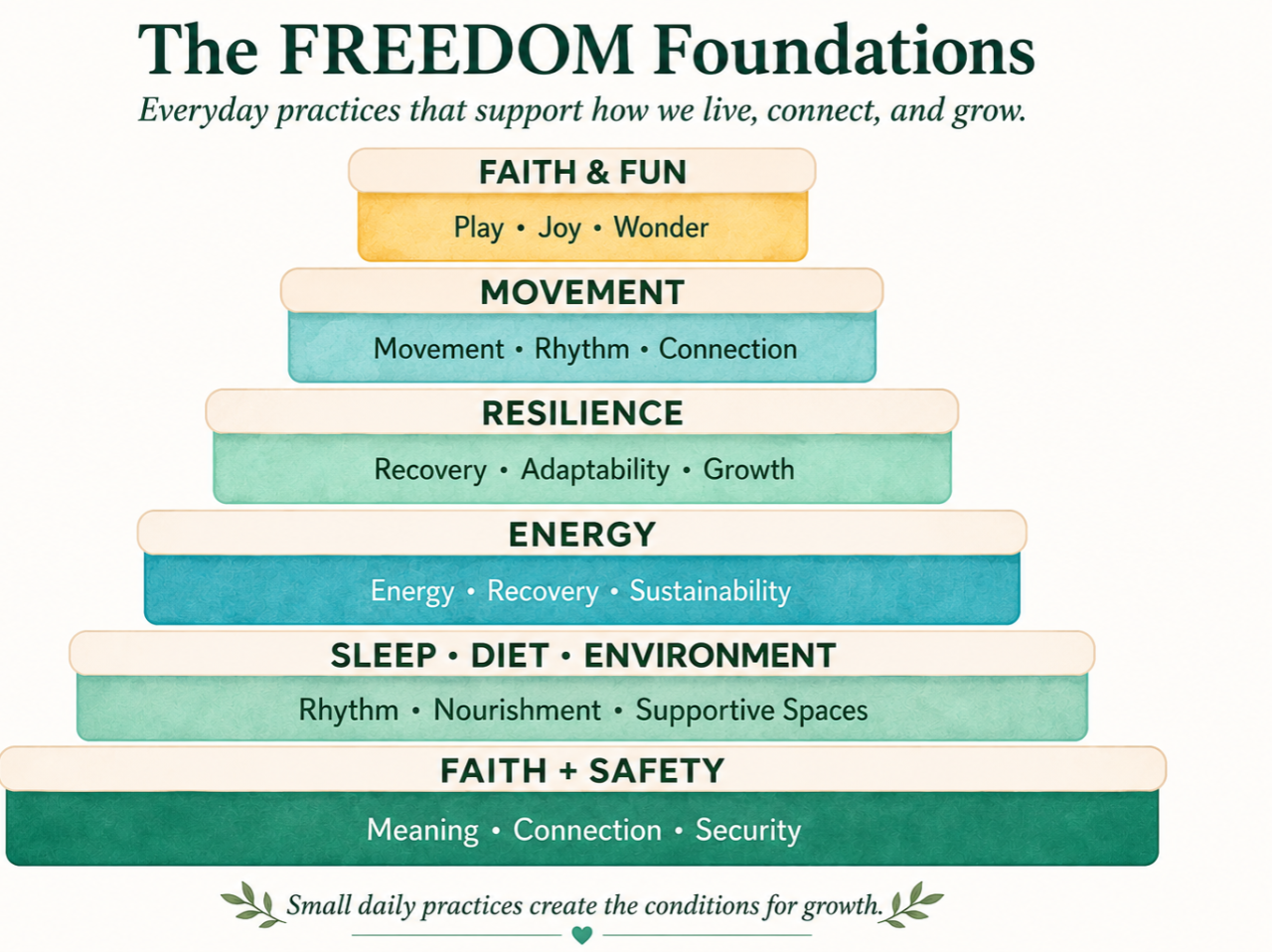
Where Understanding Becomes Action
Understanding patterns is often the beginning—not the finish line.
Awareness can create new choices, but lasting change is usually built through supportive relationships, everyday practices, and environments that make growth easier to sustain over time.
The FREEDOM Foundations represent the daily supports that help strengthen resilience and create conditions for long-term growth.
If you want to explore these ideas further, Soul Essentials Health & Wellness offers resources designed to help individuals and families better understand patterns, build supportive rhythms, and move forward with greater confidence. Explore through:
- Trauma-informed courses
- Educational blog articles
- Wellness consultations
- The Burnt, Not Broken Method

Free to BMe
My story is what happens when burnout doesn’t just interrupt your life—it dismantles what you spent decades building and forces you to ask questions you never knew to ask.
For most of my life, I thought more effort, more learning, and more love would make things feel easier. I believed if I worked hard enough, cared deeply enough, and learned enough, things would eventually settle into place.
Instead, life invited questions I never expected to ask—even with years of experience, education, and every reason to believe I was doing everything “right.”
What followed wasn’t one breakthrough moment. It was a gradual shift in how I understood stress, expectations, responsibility, and the quiet ways many of us learn to keep going long after we needed support. I can see now that I wasn’t failing. I was carrying more than I understood—and trying to solve it with more effort, more learning, and more love.
What felt confusing slowly became clearer. The stress wasn’t random. The overwhelm had roots. The patterns weren’t personal flaws—they were learned, practiced, and reinforced long before anyone had language for them. Looking back gave me language I didn’t have then—not to judge the past, but to move forward differently.
Now, I offer women a different way of understanding themselves—not as something to fix, but as something worth understanding. I bring together lived experience, more than 30 years across healthcare, care coordination, leadership, coaching, and community support, along with a deep curiosity about how our experiences shape the way we live, connect, and move through life.
My approach is grounded, practical, and realistic for real life—with enough lightness to remind us we don’t have to carry everything so seriously. That perspective became the foundation of the Burnt, Not Broken Method and the FREEDOM Foundations—everyday practices that support how we live, connect, and grow.
Burnt? Maybe.
Broken? Never.
What We Do
The women I work with are often raising children, managing households, and balancing work and family responsibilities. They don’t need complicated wellness routines—they need practical tools that meet them where they are.
Today my work focuses on supporting women to understand the hidden patterns that quietly lead to burnout so they can rebuild their capacity and show up differently in their lives and families.
When a mother’s nervous system becomes more regulated, the ripple effect reaches far beyond her own well-being. Children benefit.
Relationships shift. Families grow stronger. Because when women understand the connection between stress, nervous system regulation, and early life experiences, they gain the ability to break the push–collapse cycle and create a healthier path forward—for themselves and for the next generation.
Your kitchen is the heart of your home and of your health. Let’s kick the confusion out of the kitchen. We’ll put together a game plan for grocery shopping, meal prepping, cooking (yes, even the ‘what’s for dinner?’ panic), so you can make mindful, feel-good food choices without losing your sanity....or living off cereal.
From restful sleep to navigating life’s challenges with confidence, your daily choices play a big role in your health. I’ll guide you in building habits that nurture your energy, boost your confidence, and encourage self-compassion—helping you create a life that feels vibrant, sustainable and in harmony. Resilience is possible!
By combining science-based strategies with a holistic approach, we tap into the power of awareness to drive lasting transformation. When you understand how your mind, body, and emotions work together, change becomes natural—helping you thrive in ways that truly align with your needs.
Credentials
Vicki Johnson, MS, BSH, CFHC – Trauma-Informed Certified Functional Health Coach
As a mother of two and a grandmother of three, I bring both professional training and real-life experience to my work with women and families.
My goal is simple: To help women move out of survival mode and build the nervous system capacity needed to live with greater energy, clarity, and connection.
- Certified Functional Health Coach (2019)
- Advanced level Biology of Trauma training (2019-2023)
- Master’s Degree in Organizational Leadership
- Bachelor’s Degree in Health Administration
- Co- Chair WV ACEs Coalition
- HOPE Facilitator
- Youth Mental Health Trained
- Over 30 years of experience working within healthcare systems